
By Leonard Serratore | The Adventure of Lenny and Scotty
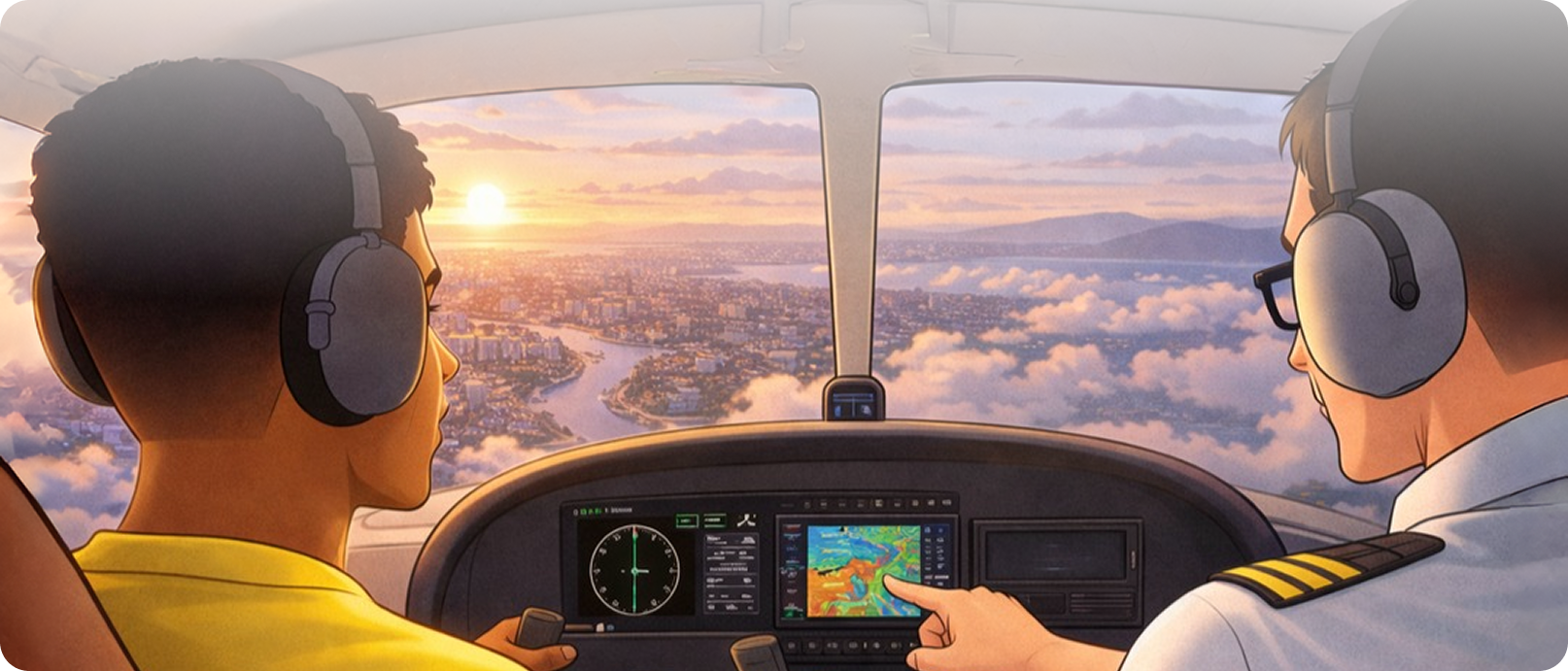
The first time most people sit in the left seat of a small airplane, they go quiet.
It’s not the view that does it, though the view is remarkable. It’s the panel. All those dials and gauges and switches and lights, stacked and clustered in a way that looks, at first, completely overwhelming. Where do you even begin? How does anyone make sense of all this?
I remember that feeling. I also remember the moment it started to make sense, when the instruments stopped being noise and started being information, when the cockpit stopped feeling like a foreign country and started feeling like home.
The cockpit is where aviation lives. It’s the command center, the workspace, and, for many pilots, the most comfortable place in the world. Understanding what’s in there and how pilots use it is one of the best ways to understand what flying really is, and what it demands from the people who do it professionally.
The Basic Six: The Foundation of Every Cockpit
Before glass cockpits with digital displays became standard, and even today in thousands of training aircraft around the world, the fundamental instrument layout is what pilots call the “Basic Six”, six primary gauges arranged in a specific pattern on the instrument panel.
Understanding these six instruments is where every pilot’s training begins.
The Airspeed Indicator tells the pilot how fast the aircraft is moving through the air, not over the ground, but through the air itself. This distinction matters because a 50-knot headwind means an aircraft traveling 100 knots through the air is only moving 50 knots over the ground. Pilots care about airspeed because lift, stall speed, and structural limits are all defined in terms of how fast air is moving over the wings.
The Attitude Indicator (sometimes called the artificial horizon) shows the pilot the aircraft’s orientation relative to the real horizon. When you are flying through clouds or at night, you can’t see the horizon outside. The attitude indicator replaces it. It shows whether the nose is pitched up or down, and whether the wings are level or banked. This instrument becomes absolutely critical when visual references disappear.
The Altimeter shows the aircraft’s altitude, how high above sea level (or above the ground, in certain contexts) the plane is flying. Altimeters work by measuring air pressure, which decreases predictably as altitude increases. Pilots set their altimeters to the current local pressure before every flight. Without an accurate altimeter, a pilot can’t be certain how much air or ground is below them.
The Turn Coordinator shows the rate and coordination of the aircraft’s turn. It has two parts: a miniature airplane that tilts to show the direction and bank of a turn, and a small ball inside a curved tube that shows whether the turn is coordinated (the ball centered) or slipping/skidding (the ball off to one side). Learning to keep the ball centered is one of the first coordination lessons in flight training.
The Heading Indicator shows the aircraft’s magnetic heading, which direction the nose is pointing. It’s essentially a gyroscope-stabilized compass, more reliable in turbulence and turns than the magnetic compass, which can swing and oscillate when the aircraft is maneuvering.
The Vertical Speed Indicator shows how fast the aircraft is climbing or descending, typically in feet per minute. A 500 feet-per-minute climb. A 300 feet-per-minute descent. It gives the pilot a rate, not just a direction, which is important for precise altitude management.
Six gauges. But when you understand them together, they paint a complete picture of where the aircraft is and what it’s doing at every moment.
The Controls: Hands and Feet
The cockpit is not just about reading information. It’s about acting on it. And the pilot’s primary tools are the control yoke (or stick) and the rudder pedals.
The control yoke, that column or wheel in front of the pilot’s seat, controls the aircraft’s pitch and roll. Pull it back, and the nose rises. Push it forward, and the nose drops. Turn it left and the aircraft banks left; turn it right, and it banks right. It sounds simple, but coordinating these inputs smoothly and precisely takes months of practice.
Some aircraft use a control stick instead of a yoke, a single joystick-style control between the pilot’s knees. Fighter jets and many modern light aircraft use sticks. The principle is the same; the feel is somewhat different.
The rudder pedals on the floor control the aircraft’s yaw, its tendency to swing left or right around its vertical axis. In a coordinated turn, a pilot uses both the yoke (for bank) and the appropriate rudder pedal (to keep the nose tracking properly through the turn). New students often forget about the rudder, letting the aircraft skid or slip through turns. Learning to use all the controls together, fluidly, is the physical heart of learning to fly.
There’s also the throttle, typically a lever in the center console that controls engine power. More throttle equals more thrust equals more speed and climb capability. Managing throttle in coordination with control inputs is part of what pilots mean when they talk about “flying the aircraft” as a whole-body skill.
Modern Avionics: The Glass Cockpit
Walk into the cockpit of a modern commercial airliner, or even many new small training aircraft, and the Basic Six are gone. In their place are large digital screens called Primary Flight Displays (PFD) and Multi-Function Displays (MFD).
These screens consolidate all the traditional instruments into digital representations, but they also add layers of information that analog gauges could never provide: terrain awareness, traffic alerts, weather overlays, moving maps, engine performance data, and navigation information all integrated in one place.
GPS navigation systems allow pilots to plan routes, program approaches, and track their position with extraordinary precision. Autopilot systems can manage heading, altitude, and even approach procedures with minimal pilot input, though pilots never fully hand over control. They monitor, manage, and remain ready to intervene at any moment.
The modern cockpit is, in many ways, an information management environment. The pilot’s job is as much about interpreting data and making decisions as it is about hand-flying the aircraft. But the fundamental skills, reading attitude, managing airspeed, and staying ahead of the aircraft never change. Technology adds capability. Judgment and skill are irreplaceable.
What It Feels Like
I have sat in cockpits ranging from single-engine trainers to multi-engine turboprops, from small airport operations aircraft to the flight decks of commercial jets. Every one of them has that same quality, a sense of contained purpose. Everything in a cockpit is there for a reason. Nothing is wasted. Everything points toward the mission of getting airborne and arriving safely.
When Lenny and Scotty get their first real look inside a cockpit in the book, it’s one of those moments that expands their sense of what’s possible. Not because the cockpit is glamorous, though it is, in its way. But because it makes the dream specific. It turns the vague, sky-gazing wish of childhood into something concrete, learnable, achievable.
That’s what the cockpit represents. Not just a room full of instruments. A place where preparation meets opportunity. A place where, if you have done the work, you get to belong.