By Leonard Serratore | The Adventure of Lenny and Scotty
There’s a moment every kid has, standing in a backyard or a parking lot, neck craned back, watching a silver shape slice through the blue, and wondering: How does that thing stay up there?
I had that moment more times than I can count growing up in Nyack, New York. I’d watch the planes pass over and feel something pull in my chest, like the sky was calling me by name. That feeling never went away. It led me through 37 years in airport management, through a degree from Florida Institute of Technology, and through a life created completely around aviation. And it’s exactly the feeling I wanted to pass on when I wrote The Adventure of Lenny and Scotty.
But before you can dream about flying, it helps to understand what flying actually is. Not in a textbook way. In a real, human, is n’t-that-incredible way. So let’s talk about how planes work, and why the science behind them is just as magical as the dream.
It All Starts With a Wing
The first thing you need to know about airplanes is that almost everything depends on the wing. Not the engine or cockpit. The wing.
Wings are shaped in a very specific way. If you were to look at a cross-section of a wing from the side, called an airfoil, you’d notice the top curves upward while the bottom stays relatively flat. This shape isn’t random. It’s the result of over a century of engineering and experimentation, and it creates something called lift.
Process of how it works: when an airplane moves forward, air splits at the front edge of the wing. The air going over the top has a longer path to travel because of that curve, so it moves faster. The air going underneath travels a shorter, flatter path and moves more slowly. Faster-moving air creates lower pressure. Slower-moving air creates higher pressure. And since nature always tries to equalize pressure, the higher pressure below pushes up against the lower pressure above.
That push upward is a lift. It’s what gets 400 tons of aircraft off the ground.
It sounds simple when you say it like that. But there’s a quiet beauty in how something as invisible as air pressure can hold a machine the size of a building in the sky. When Lenny and Scotty first learn this in the book, it’s one of those light-bulb moments, the kind that makes you see the world differently.
The Four Forces of Flight
Wings create lift, but lift alone doesn’t explain everything. To truly understand how a plane flies, you need to know about the four forces that are always acting on an aircraft, fighting each other, balancing each other, keeping everything in check.
Lift pushes the plane up. We have covered that.
Weight (or gravity) pulls the plane down. Every pound of fuel, luggage, passenger, and aircraft is constantly being tugged toward the earth. The pilot’s job is to make sure the lift is always at least equal to the weight during flight.
Thrust pushes the plane forward. This comes from the engines, either jet turbines or propellers. Without thrust, the plane slows down, loses airspeed, and eventually loses lift. Forward motion and lift are inseparable.
Drag works against thrust, slowing the plane down. Air resistance is real, and aircraft designers spend enormous energy trying to reduce drag, which is why planes are sleek and tapered, nothing like a brick wall pointing into the wind.
These four forces are in constant conversation during every second of every flight. When a pilot climbs, descends, speeds up, or slows down, they are adjusting this conversation. It’s less like driving a car and more like conducting an orchestra; everything has to be in harmony.
What the Engines Actually Do
When most people think about planes, they think about engines. Those big cylinders hanging under the wings, roaring at takeoff, quieting as the plane reaches cruising altitude.
Jet engines work on a principle called thrust reaction; for every action, there’s an equal and opposite reaction. The engine sucks in air from the front, compresses it, mixes it with fuel, ignites it, and then blasts the resulting hot gas out the back. The forward push against that backward blast is what drives the plane through the sky.
Propeller powered aircraft work slightly differently. Instead of hot exhaust, spinning propeller blades bite into the air and pull the plane forward, similar in principle to how a boat propeller works, just in a thinner medium.
Both systems are converting fuel into motion. And motion, combined with a good wing, becomes flight.
When I was assembling model aircraft as a kid in Nyack, the same way Lenny does in the book, I didn’t fully understand all this science yet. But my hands were learning the shapes. My eyes were learning the proportions. My imagination was connecting the pieces long before my mind had the vocabulary for them.
The Control Surfaces: Steering the Sky
An airplane doesn’t have a steering wheel, not in the conventional sense. It has control surfaces, movable parts of the wings and tail that change how air flows around them, which in turn changes the direction and attitude of the plane.
The ailerons are on the back edges of the wings. When you bank left, the left aileron goes up, and the right goes down. This changes the lift on each wing, causing the plane to roll.
The elevator is on the horizontal part of the tail. Pull back on the controls, the elevator goes up, and the nose pitches upward. Push forward, the nose drops.
The rudder is the vertical fin at the back. Pressing the left rudder pedal pushes the nose left; the right pedal pushes it right. Unlike a car, you don’t steer a plane with your hands alone; your feet are in the conversation too.
Together, these surfaces give pilots three-dimensional control in a three-dimensional environment. It takes practice to coordinate all of them smoothly, but when it clicks, pilots often describe the sensation as the plane becoming an extension of themselves.
More Than Mechanics
I have been around aviation long enough to know that the mechanics, as fascinating as they are, are not what hooks people. What hooks people is the feeling.
The feeling of takeoff, when you are pressed back in your seat, and the ground suddenly falls away. The feeling of looking out the window at 35,000 feet and seeing the curved edge of the world. The feeling of knowing that human beings figured out how to defy gravity on purpose.
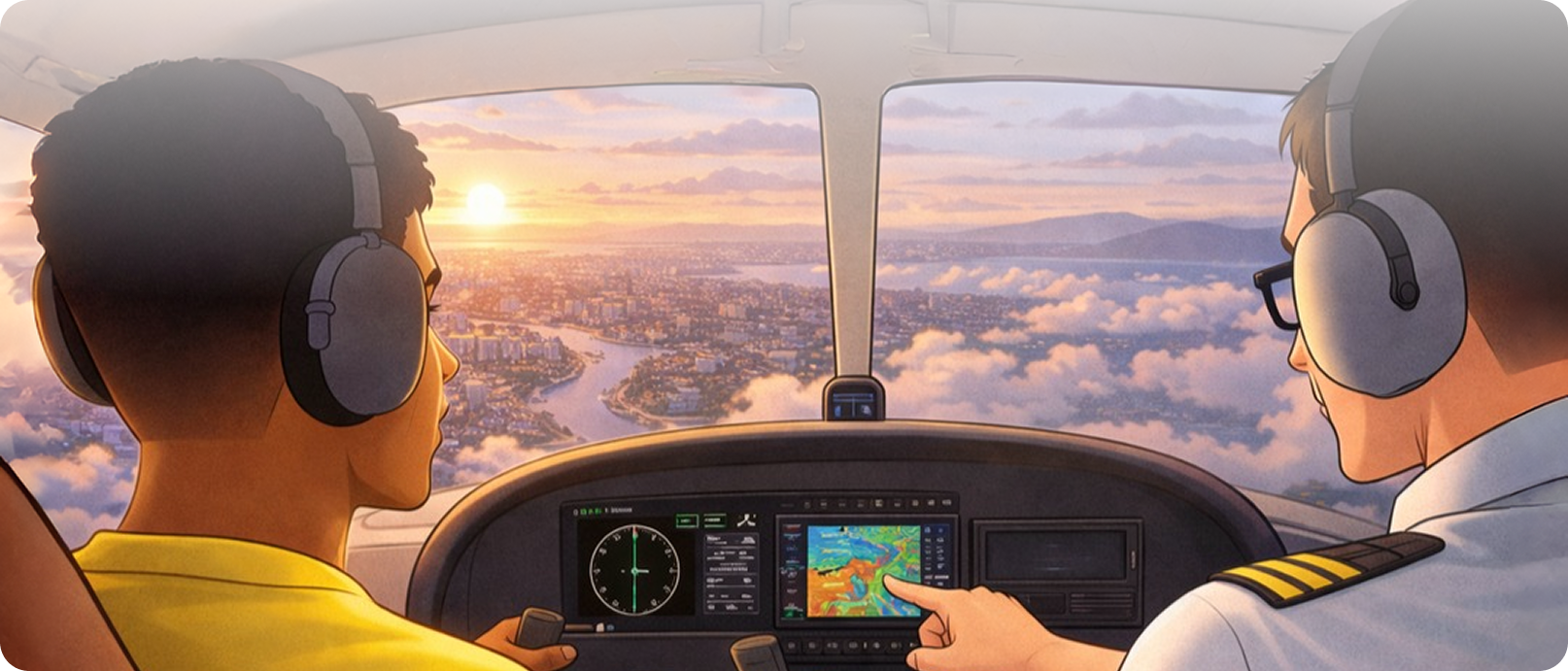
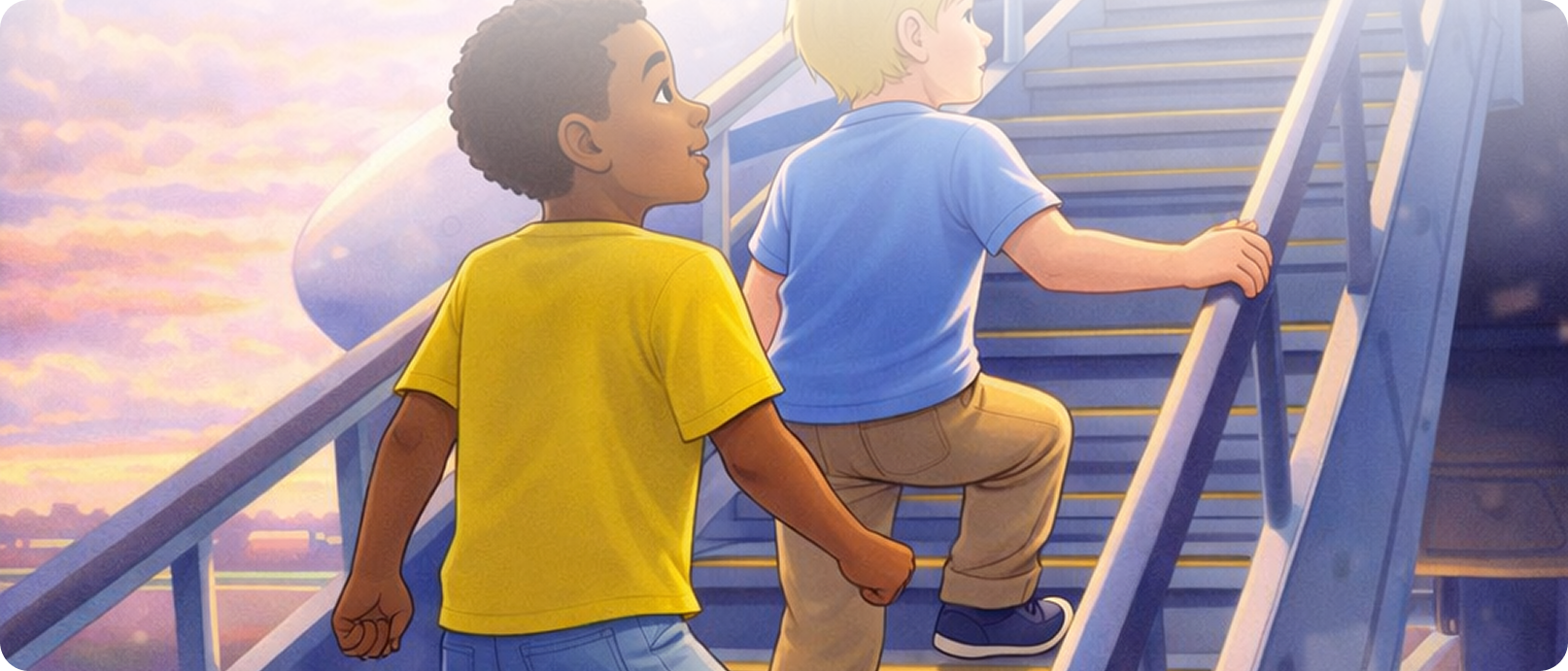
Scotty and Lenny, the two boys at the heart of my book, aren’t drawn to aviation because they read textbooks about lift and drag. They are drawn to it because they feel something when they look up. The science comes later, in service of a passion that arrived first.
That’s how it works for most of the great pilots and aviation professionals I’ve known over my 37-year career. The dream comes before the knowledge. But once you start learning why planes fly, that dream gets stronger, not weaker. Every answer opens up ten new questions. Every answer is another reason to look up.
Understanding how planes work doesn’t demystify the sky. It makes you fall in love with it all over again.