
By Leonard Serratore | The Adventure of Lenny and Scotty
There’s a quote I included in The Adventure of Lenny and Scotty that I come back to often:
“Aviation is terribly unforgiving of any carelessness, incapacity, or neglect.”
It sounds severe. Maybe even a little frightening. But after 37 years working in airport management, watching aircraft come and go, watching pilots and controllers work together, watching the entire choreography of aviation unfold every single day, I can tell you that this quote is not meant to scare anyone away from the sky. It’s meant to explain why aviation culture takes safety so seriously, and why the rules that govern the sky are not bureaucratic annoyances. They are the reason we can trust flight at all.
The sky is big. Enormously, incomprehensibly big. But the corridors through which aircraft travel are surprisingly properly defined, and managing those corridors requires communication, discipline, and a shared language that every pilot, controller, and crew member understands. Let’s discuss how all of that works.
The Sky Is Divided: On Purpose
When you look up and see a clear blue sky, it might look like open country, go anywhere, do anything. But from an aviation perspective, the sky is divided into very specific chunks of regulated airspace, each with its own rules about who can fly there, how high, how fast, and under what conditions.
In the United States (and in most countries worldwide, thanks to international standards), airspace is categorized alphabetically. Class A airspace starts at 18,000 feet, the domain of commercial jets flying coast to coast. Class B airspace wraps around the busiest airports, like Chicago O’Hare or Atlanta Hartsfield. Classes C and D cover smaller commercial and regional airports. Class E and G airspace covers much of the rest, smaller airports, rural areas, and low-altitude corridors.
Each class has different requirements. To fly in Class B airspace, for example, a pilot needs a specific clearance from air traffic control. To fly in Class A, you must be flying under instrument flight rules, meaning you’re certified to navigate using cockpit instruments, not just visual reference to the ground.
This structure is not arbitrary. It exists because the more traffic an area has, the more coordination is required. Stacking aircraft without organization would be like taking every car from every highway in the country and dropping them all onto one intersection with no traffic lights, no lanes, and no signals. The results would be catastrophic.
Radio Communication: The Language of the Sky
If you’ve ever overheard a cockpit radio transmission, that fast, clipped exchange between pilot and controller, you might have thought it sounded like another language. In a way, it is.
Aviation radio communication has its own vocabulary, its own rhythm, and its own strict rules. Pilots learn early that radio calls must be clear, concise, and follow a specific format. There’s no room for rambling. When a controller is managing a dozen aircraft at once, clarity is not just polite, it’s important.
A standard radio call usually includes the aircraft’s identifier (its tail number or flight number), the recipient, and the message. Controllers respond in kind. When an instruction is given, the pilot reads it back, every time, to confirm they received it correctly. This readback culture is one of the most important safety habits in all of aviation. Miscommunication in the air can have consequences that can’t be undone.
There’s also the phonetic alphabet, Alpha, Bravo, Charlie, Delta, Echo, and so on. Pilots use it to spell out letters when ordinary pronunciation might cause confusion. (Did you say “B” or “D”? On a noisy radio at altitude, those two letters can sound remarkably similar.) The phonetic alphabet removes ambiguity. It’s another example of how aviation builds layers of protection against human error.
When Lenny and Scotty begin their training in the book, learning to communicate on the radio is one of those moments that makes the dream feel real. It’s not just talking about flying anymore. It’s using the actual language of the sky.
VFR and IFR: Two Ways of Seeing
Pilots operate under one of two rule sets when they fly: Visual Flight Rules (VFR) or Instrument Flight Rules (IFR).
Under VFR, pilots navigate primarily by looking outside the cockpit, keeping visual reference with the ground, using landmarks, staying clear of clouds and bad weather. VFR flying is what most student pilots learn first, and it’s how the majority of small general aviation aircraft operate on clear-weather days.
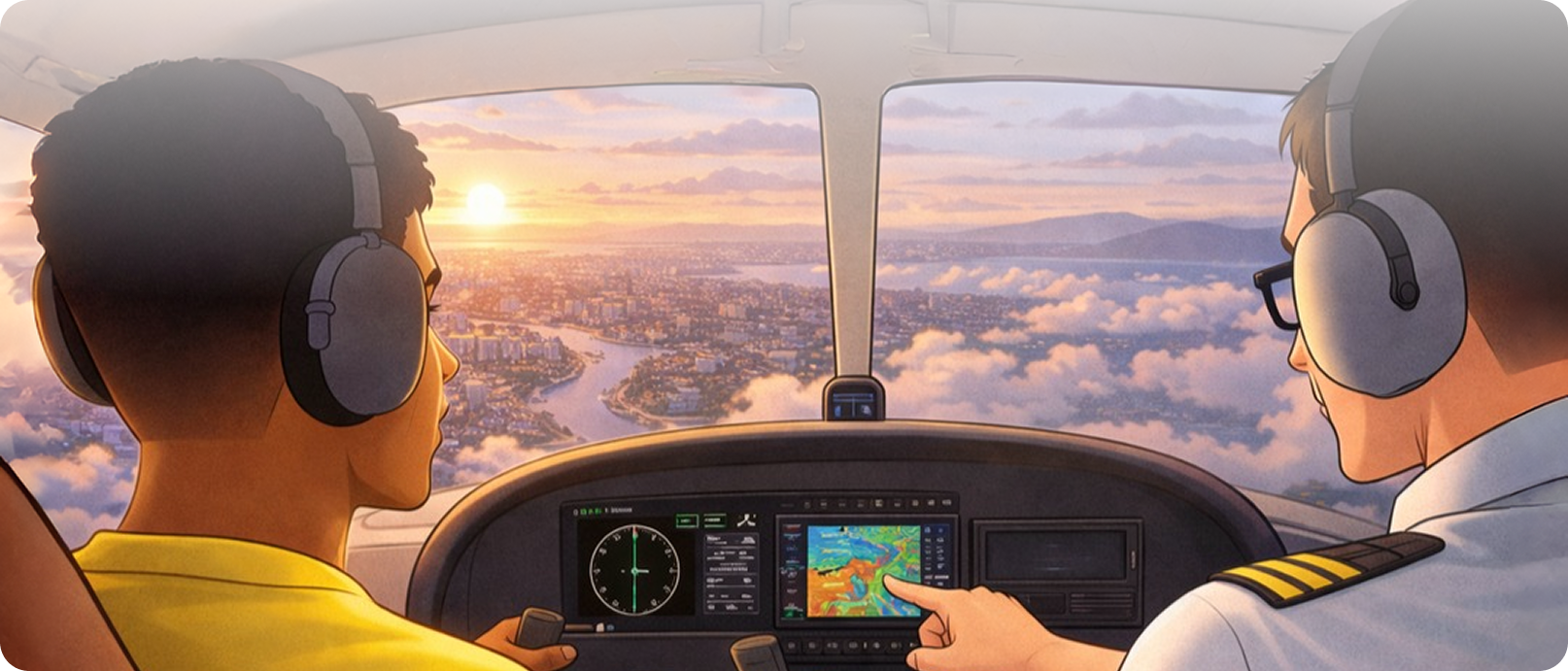
IFR is a different game entirely. When clouds close in, when visibility drops, when a pilot is flying through weather or at night, they transition to IFR, navigating entirely by cockpit instruments. Altimeters, attitude indicators, heading indicators, GPS systems, and a whole panel of gauges replace the horizon as the pilot’s primary reference.
Learning to fly IFR takes significant additional training and certification. It requires a pilot to trust instruments completely, even when their body is telling them something different. The human inner ear, it turns out, is a terrible navigator in low visibility. It lies. Pilots learn to ignore it and trust the panel instead.
The transition between VFR and IFR is one of the most fascinating journeys in a pilot’s education, and it’s part of what I wanted young readers of Lenny and Scotty to glimpse: the idea that mastery in aviation isn’t a single destination. It’s a series of doors, each one opening onto a wider sky.
Air Traffic Control: The Unsung Heroes of Aviation
Most people who fly know that pilots are up front, making decisions. Fewer people think about the people on the ground whose voices fill the cockpit from pushback to touchdown.
Air traffic controllers are among the most skilled professionals in any field. At a busy airport or en-route center, a single controller might be managing a dozen or more aircraft simultaneously, issuing altitude assignments, routing instructions, spacing aircraft for landing sequences, and handling weather deviations, all while speaking in calm, measured tones that give no hint of the mental load they are carrying.
The relationship between pilot and controller is built on mutual trust and professionalism. Pilots trust that the controller’s instructions are correct and safe. Controllers trust that pilots will execute those instructions precisely. When the system works, and it almost always does, it’s one of the most elegant examples of human coordination you will ever witness.
I spent 37 years on the operations side of airports, and I never stopped being impressed by the work controllers do. When I wrote about the world of aviation for young readers, I wanted them to understand that flying isn’t a solo act. It’s a team sport with very high stakes.
Why Rules Enable Freedom
There’s a paradox at the heart of aviation rules: they seem restrictive, but they actually create freedom.
Because every pilot follows the same communication standards, any pilot can fly to any airport and be understood. Because airspace is structured, pilots can share the sky with thousands of other aircraft without chaos. Because procedures are standardized, a pilot who learned to fly in New York can land safely in Los Angeles, Tokyo, or London.
Rules, in aviation, are not the opposite of adventure. They are what make adventure possible.
Scotty and Lenny learn this through their journey. The discipline they develop, in training, in study, in practice, is not something that limits them. It’s what gives them access to the sky. And the sky, once you earn your way into it, is as free as anything you will ever experience.
The rules of the sky exist because the sky is worth protecting, and because every person on every aircraft deserves to arrive safely.
That’s a rule worth following.